
What is a Glovebox?
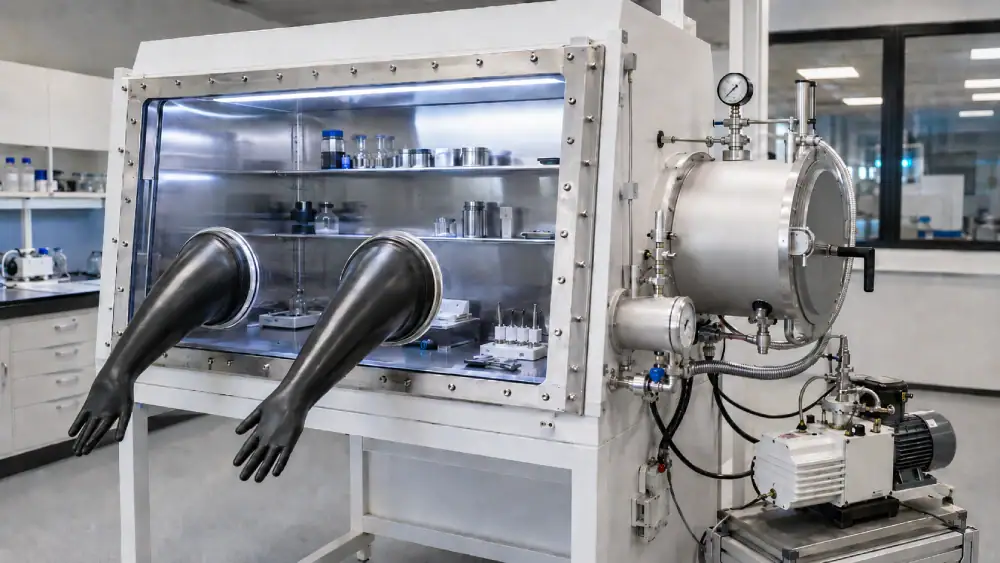
A glovebox is a sealed enclosure that lets an operator work with sensitive materials inside a controlled atmosphere — typically nitrogen or argon held at parts-per-million levels of moisture and oxygen.
The operator works through gloves built into the front window, handling everything inside without ever exposing the contents to ambient air. When a material would oxidize, absorb moisture, or become hazardous on contact with the open lab environment, it lives inside a glovebox.
Wafer & Device Handling
Wafer handling, die attach, and packaging of moisture-sensitive devices.
Cell & Electrolyte Assembly
Lithium foil handling, electrolyte filling, and cell assembly under argon.
Reactive Metal Powders
Loading, sieving, and reclaiming reactive metal powders like titanium.
Air-Sensitive Chemistry
OLED and perovskite research, and air-sensitive materials synthesis.
In every case, the quality of the atmosphere determines the quality of the result: product yield, build integrity, or experimental validity.
The vacuum pump is the workhorse behind every glovebox transfer. Nothing passes directly into the main chamber — materials enter and exit through an antechamber, a small transfer chamber mounted on the side of the glovebox with a door to the outside and a door to the interior.
Before the inner door can open, the pump must evacuate the antechamber and backfill it with inert gas, often through several repeated pump-purge cycles that flush out residual air. A busy glovebox cycles its antechamber dozens of times per shift, so evacuation speed directly sets your throughput.
Beyond transfers, the same pump handles initial pull-down when commissioning or recovering the main chamber, and drives the purge and regeneration cycles that keep the atmosphere and gas purifier within spec.
Our white paper breaks down exactly how each vacuum technology performs in glovebox service — with benchmark data to back it up.
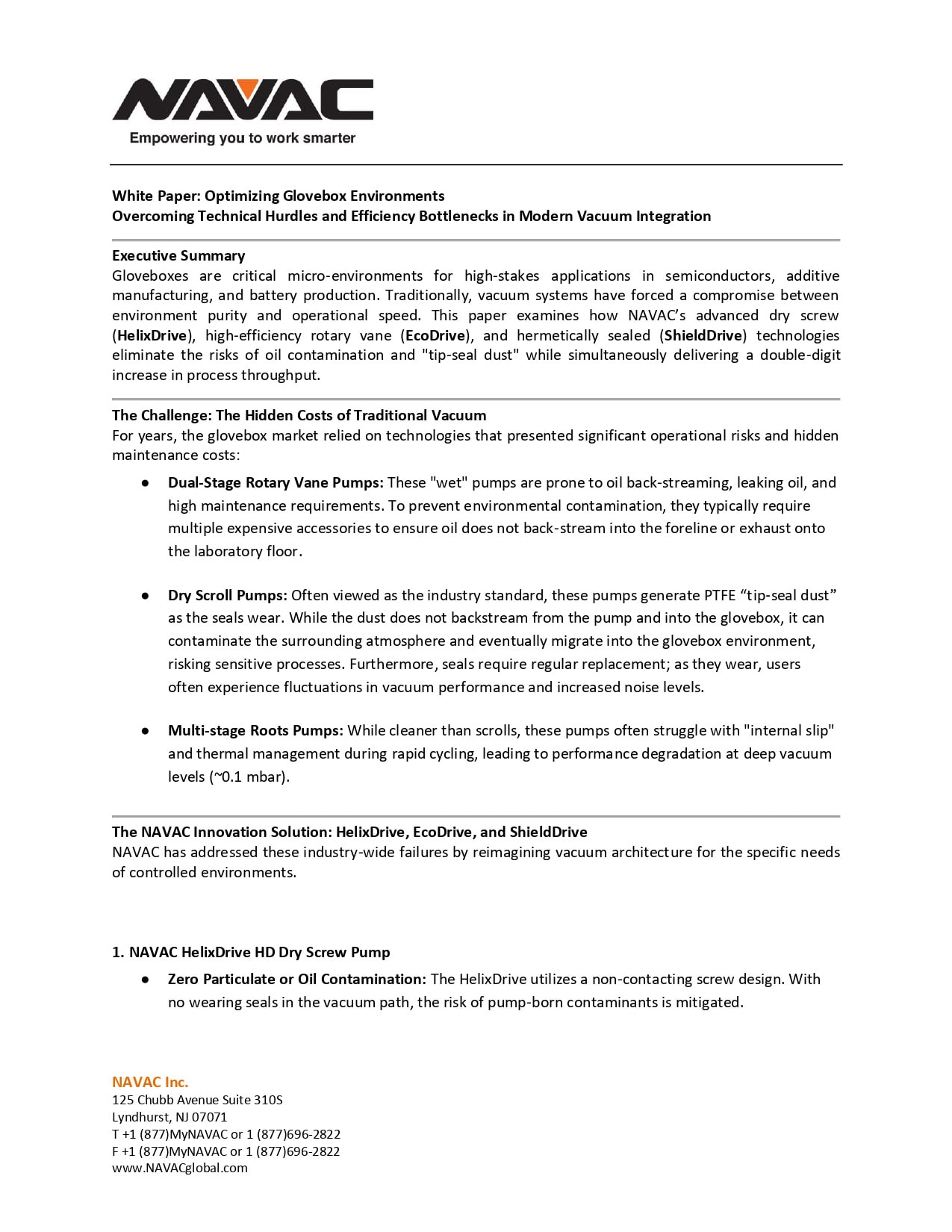
Optimize Glovebox Performance with Smarter Vacuum Technology
Overcoming Technical Hurdles and Efficiency Bottlenecks in Modern Vacuum Integration
Glovebox performance depends on more than atmosphere control. The wrong vacuum technology can introduce contamination risks, increase maintenance requirements, and slow critical processes.
Download NAVAC’s latest white paper to learn how modern vacuum solutions are helping manufacturers improve glovebox efficiency while maintaining the clean environments required for advanced applications.
You'll learn:
- The hidden costs of traditional rotary vane, scroll, and roots vacuum technologies
- How contamination risks can affect sensitive glovebox processes
- Strategies for reducing maintenance and downtime
- Methods for accelerating purge cycles and antechamber recovery times
- Benchmarking data comparing modern vacuum technologies
Eliminate Contamination Risks
Learn how dry screw and magnetically coupled technologies minimize oil contamination, leaks, and particulate generation within controlled environments.
Reduce Maintenance
Discover solutions designed to eliminate routine seal replacements and reduce the need for costly accessories and service interventions.
Increase Productivity
See how optimized vacuum performance accelerates nitrogen cycles, antechamber recovery, and full-system pull-down times.

HelixDrive™
Dry Screw Pumps
Non-contacting screw technology designed for clean, reliable operation in demanding glovebox environments.

EcoDrive™
Rotary Vane Pumps
High-efficiency brushless DC motor technology delivering strong performance and energy-saving operation.

ShieldDrive™
Magnetically Coupled Rotary Vane Pumps
Hermetically sealed, magnetically coupled design engineered to eliminate leaks while simplifying maintenance.
Everything you need to optimize glovebox performance and improve operational efficiency.
Complete the form below to download our whitepaper.